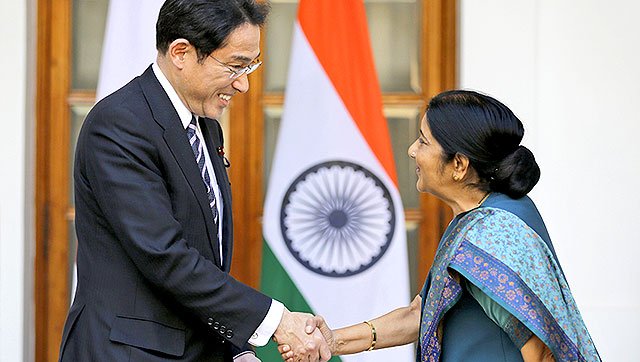
Prime Minister Fumio Kishida visited India for the first time as Japan’s new leader. He said Japan must build a stronger Indo‑Pacific partnership. He also said Japan should grow closer to India because they share values that differ from China.
Why values are important
Kishida said the first area of cooperation is “values and spirit”. He listed three ideas:
- Rule of law and democracy – a system where the majority decides but the law protects everyone.
- Open and lively economy – free trade, flexible markets and chances for businesses.
- Open and stable oceans – safe sea routes for shipping and travel.
He added that both countries should work together on global issues like United Nations Security Council (UNSC) reform and fighting terrorism.
Economic cooperation and big projects
During the visit, Kishida met Indian leader Sushma Swaraj. Swaraj talked about a 15 % rise in Japanese investment in India last year. She said Japan is a key partner in the “Make in India” programme, which encourages companies to build things inside India.
Kishida called India the “most reliable partner for Japanese companies”. He said Japanese firms see India as a safe place to invest and grow.
The two leaders toured two major projects:
- The Dedicated Freight Corridor – a rail line that will move goods quickly across the country.
- The High‑Speed Rail link planned between Ahmedabad and Mumbai – a fast train that will cut travel time.
Both projects show how Japan can help India build better infrastructure.
Security and defence ties
Kishida and Swaraj also talked about defence cooperation. They agreed to strengthen political and security ties.
They reviewed progress on the US‑2 amphibious aircraft, a plane that can land on water and help in rescue missions.
Other security topics included:
- UNSC reform – changing how the United Nations Security Council works.
- The Indo‑Pacific region – keeping the sea lanes safe and free.
- Afghanistan – discussing how to support stability there.
These talks show that Japan and India want to work together on both economic and security matters.
How this differs from China
Kishida said the values shared by Japan and India do not match those of China. He did not list specific Chinese policies, but he highlighted the importance of democracy, rule of law and open markets – ideas that differ from China’s more controlled system.
By focusing on shared values, Japan hopes to create a partnership that can balance China’s influence in the region.
Future steps and what to watch
Both sides said they will keep talking about more projects. They will look for ways to increase Japanese investment in India.
They will also keep meeting on security topics, especially the UNSC reform and keeping the Indo‑Pacific sea routes safe.
Observers say that deeper Japan‑India ties could lead to more trade, more jobs and a stronger regional security network.
FAQ
What did Kishida mean by “values and spirit”?
He meant that Japan and India share democracy, rule of law, open markets and a desire for peaceful oceans. These are the ideas that will guide their partnership.
Why is the 15 % increase in Japanese investment important?
A 15 % rise shows that Japanese companies trust India’s market. More investment can bring jobs, technology and better infrastructure.
What are the Dedicated Freight Corridor and the High‑Speed Rail?
The Dedicated Freight Corridor is a special railway for moving cargo fast. The High‑Speed Rail will connect Ahmedabad and Mumbai, cutting travel time dramatically.
How does this partnership affect China?
Japan says its partnership with India is based on values that differ from China’s. By working together, Japan and India hope to offer an alternative to China’s influence in the Indo‑Pacific.
Conclusion
Prime Minister Fumio Kishida’s visit to India marked a clear push for deeper Japan‑India ties. The focus is on shared democratic values, big economic projects and strong security cooperation. Both countries see each other as reliable partners. The partnership aims to create a balanced and stable Indo‑Pacific region, offering a different path from China’s approach.