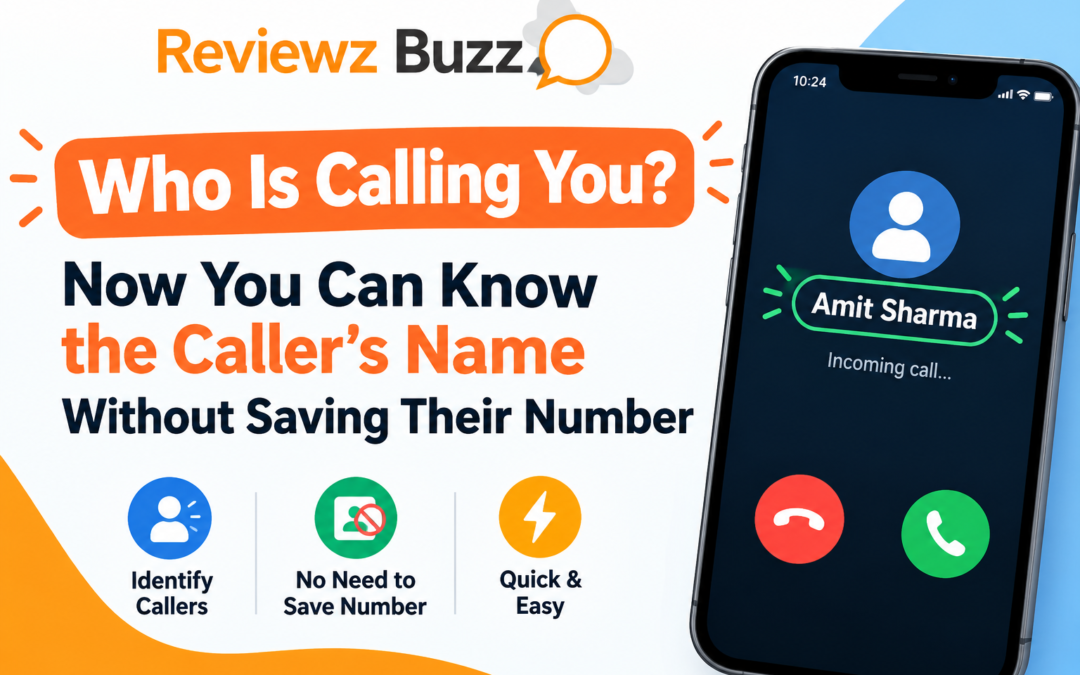
Who Is Calling You? Now You Can Know the Caller’s Name Without Saving Their Number
We often receive calls from unknown numbers on our phones. At such times, the first question that comes to mind is: Who is calling me? Some people answer the call, thinking it might be important, while others simply disconnect it because they do not recognise the number.
To make this easier, a new feature called CNAP (Calling Name Presentation) is being introduced in India. With this feature, mobile users will be able to see the caller’s name along with the number when receiving a call from an unknown number.
This means you may no longer need to save every number in your contact list just to know who is calling.
What Is CNAP Service?
CNAP stands for Calling Name Presentation. It is a feature that allows the name of the person making a call to appear on the receiver’s mobile screen.Currently, when someone calls from an unknown number, users generally see only the mobile number on their screen. However, with CNAP, the caller’s registered name may also appear along with the number.This service is part of an initiative by the Department of Telecommunications (DoT) and will be provided through telecom operators’ networks.
How Can You Know Who Is Calling Without Saving Their Number?
The working of CNAP is quite simple. When someone calls your mobile number, the telecom network will use the caller’s registered subscriber details to help display their name on your screen.
For example, if you receive a call from a number that is not saved in your contact list, your phone may display the caller’s registered name along with their mobile number.
This will help you get an idea of who is calling before answering the phone.
Will CNAP Remove the Need for Truecaller?
Today, many people use apps like Truecaller to identify unknown callers. However, CNAP works differently.
Apps like Truecaller use their available databases and user-contributed information to identify callers. On the other hand, CNAP uses registered subscriber information available through telecom networks.
With CNAP, people may become less dependent on third-party apps to identify unknown callers.
4G and 5G Users Will Benefit
The CNAP service is primarily planned for 4G and newer-generation networks, including 5G.
Separate arrangements may be required for 2G and 3G networks. Its availability will depend on telecom operators’ preparations and network support.
Can CNAP Help Reduce Fake Calls and Cyber Fraud?
Today, mobile users receive many fake calls in the name of banks, KYC verification, jobs, lotteries, and delivery services. Sometimes, people trust these calls without knowing who is actually contacting them.
By displaying the caller’s registered name, CNAP may help users identify unknown callers more easily.
However, this does not mean that every call will be safe. Even if a name appears on your screen, you should never share your OTP, banking details, passwords, or other sensitive information with an unknown caller.
Why Is This Feature Important for Mobile Users?
One of the biggest advantages of CNAP is that it could make identifying unknown callers easier.
Here are some of its key benefits:
Users can see the caller’s registered name without saving the number.
- It may help people distinguish between important and unknown calls.
- Users can get more information before answering a call.
- It may help people avoid unwanted calls.
- It could improve the overall calling experience for mobile users.
Conclusion
CNAP could be a useful development for mobile users in India. When someone calls from an unknown number, users may be able to see the caller’s registered name instead of just seeing the mobile number.This could make everyday calls easier to identify and provide some relief to people who frequently receive calls from unknown numbers.
However, it is still important to stay cautious while speaking to unknown callers and follow basic online safety practices.
Sources: Department of Telecommunications (DoT), Government of India – Official CNAP implementation instructions.